.png)
John Keats and Jane Campion Bright Star: Text Guide

Published on
September 21, 2026
Table of Contents
There is something quietly audacious about pairing John Keats' Romantic lyric poetry with Jane Campion's 2009 biopic Bright Star. One is a body of work shaped by tuberculosis, financial precarity, and the desperate desire to leave something beautiful behind before dying at twenty-five. The other is a twenty-first century film made by a modern director consciously positioning herself against the very tradition that made Keats famous. And yet the Module A rubric calls this a ‘textual conversation’ — not just because the two texts agree, but because of how productively they argue.
The HSC's concept of textual conversation names something specific: not just shared themes, but the way a later text reimagines or reframes an earlier one, using the distance of time, context, and medium to generate new meaning. What emerges is a dialogue that enriches both texts and asks students to understand not just what each text says, but how each text’s ideas collide.
This guide aims to familiarise you with this textual dialogue between Keats and Campion with confidence and help you achieve top marks in your Module A Keats/Bright Star Essay.
Part 1: Context
A critical component of Mod A is identifying how the contextual shift between the two texts lead to differing values, assumptions and perspectives represented in each respective work. Let’s delve into the most important elements of the two texts which you should consider when constructing your arguments around an Keats and Campion comparative essay.
John Keats: Context pillars
1. The Romantic Reaction Against the Enlightenment
Romanticism was not simply a mood. It was a philosophical and artistic rebellion against the Enlightenment's faith in reason, empiricism, and rational progress. Where the Enlightenment claimed the pursuit of science and rational perception of the world bettered humanity, Romanticism claimed a return to emotion and spiritual connection was necessary to cleanse the human soul. The Poetry Foundation defines the movement with precision:
A poetic movement of the late 18th and early 19th centuries that turned toward nature and the interior world of feeling, in opposition to the mannered formalism and disciplined scientific inquiry of the Enlightenment era that preceded it. English poets such as Wordsworth, Coleridge, Keats, Shelley, Blake, and Byron produced work that expressed spontaneous feelings, found parallels to their own emotional lives in the natural world, and celebrated creativity rather than logic.
Romantic poets rejected the idea that truth could be discovered through rational analysis alone. Instead, they valued emotion over logic, imagination over empiricism, nature over industrial society, and individual experience over universal systems. Central to this was a reverence for the natural world as a site of spiritual renewal and moral truth — a direct counter to the period's accelerating industrialisation, which the Romantics viewed as dehumanising and corruptive of the human spirit, severing mankind from the restorative rhythms of nature and replacing organic life with mechanical production.
For Keats, this translated into a belief that the imagination was not merely an escape from reality but a faculty that actively shaped it. In a letter to his friend Benjamin Bailey in 1817, he expressed it directly:
I am certain of nothing but of the holiness of the Heart's affections and the truth of Imagination — What the imagination seizes as Beauty must be truth — whether it existed before or not — for I have the same Idea of all our Passions as of Love they are all in their sublime, creative of essential Beauty.
— Letter to Benjamin Bailey, 22 November 1817
Accordingly, this philosophical claim — that beauty, apprehended through intense imaginative and emotional engagement, is itself a mode of truth — drives much of Keats’ oeuvre's ideas. In Ode on a Grecian Urn, the speaker's encounter with the silent images of the urn produces not rational comprehension but an almost painful imaginative seizing of beauty. Similarly, within On First Looking into Chapman's Homer, reading Homer through Chapman's translation triggers an experience of aesthetic revelation that Keats describes to be invaluable not as an intellectual experience but an emotional one.
2. Negative Capability and the Embrace of Ambiguity
One of Keats’ most original contributions to Romantic thought was his concept of negative capability — coined in a letter to his brothers George and Tom in 1817. He defined it as the capacity for:
...being in uncertainties, mysteries, doubts, without any irritable reaching after fact or reason.
Where other thinkers (including some Romantic philosophers) felt compelled to resolve contradiction and establish certainty, Keats argued that the finest poetry inhabits ambiguity, holds tension without forcing resolution, and trusts the reader to dwell in uncertainty.
Negative capability is an aesthetic style that distinctly makes many of Keats’ poems ‘Keatsian’.
This is why so many of his greatest poems end with questions rather than answers.
3. Biography: Mortality, Loss, and the Urgency of Art
Keats’ personal life was marked by confrontation with death from an early age. His father died when he was eight; his mother died of tuberculosis when he was fourteen. He trained as an apothecary and surgeon — a profession that gave him an intimate, clinical understanding of bodily decay. His brother Tom died of tuberculosis in 1818, and by 1819 Keats himself was exhibiting symptoms. He died in Rome on 23 February 1821, aged twenty-five.
In the midst of this accumulating loss, Keats fell deeply in love with Fanny Brawne, the daughter of a neighbouring family in Hampstead — a relationship that would become one of English literature's most celebrated romances, and the emotional centre of Campion’s film. Their love was complicated at every turn by Keats’ financial inability to marry, his deteriorating health, and the rigid social conventions of Regency England.
Adding to this physical and emotional precarity was a hostile critical reception. His early poetry was savaged in the literary press, most notoriously by Blackwood’s Magazine:
It is a better and wiser thing to be a starved apothecary than a starved poet.
The combination of illness, financial insecurity, and critical dismissal gave Keats' writing its distinctive urgency — the sense that time was running out, that recognition had not yet come, and that the poems needed to be written now. The tombstone inscription Keats chose for himself — “Here lies one whose name was writ in water” — captures Keats’ resignation of his poetic life failing to create an artistic legacy.
The bitter irony is that he could not have been more wrong. Dismissed during his lifetime and mourned as a talent extinguished before its full realisation, Keats is now considered one of the greatest of the English Romantic poets — ranked alongside Wordsworth, Byron, and Shelley as a defining voice of the movement. The anxiety that his name would be written in water has been answered, two centuries later, by Campion’s film: Bright Star was made with full knowledge of Keats’ posthumous stature, and part of its project is to show how that stature was earned not in spite of his mortality but because of it.
Keat’s biographical life becomes the direct creative fuel of much of his oeuvre. La Belle Dame sans Merci was composed in the months immediately following Tom Keats’ death from tuberculosis in 1818, and the poem’s sustained lexical field of decay and its imagery of desolation and helplessness before mortality are inseparable from that personal grief. When I Have Fears that I may cease to be is Keats writing from the very anxiety of a young man already acquainted with death, fearing he will die before his pen has captured the beauty of life. Of course, it would be remiss to not mention Keats’ sonnet ‘Bright star! would I were steadfast as thou art’ is a love poem written for Fanny herself, where Keats’ own love life becomes the foundation of his poetic expression of human desire to fix their love against the inevitability of his own death.
4. The Romantic Concept of the Sublime
Central to Keats’ aesthetic world is the Sublime — that experience of overwhelming beauty or awe that exceeds the individual’s ordinary capacity for comprehension, provoking a sense of expansion, elevation, or even terror. For the Romantics, the Sublime was not merely an aesthetic category but a quasi-spiritual event: an encounter with something larger than the self that temporarily liberated the perceiving mind from its ordinary limitations.
This is the Sublime in practice: the imagination reaches toward an ideal, encounters the overwhelming real, and is stilled into a kind of reverent surrender. Keats’ poems directly seek the encounter and reckon with the limits of Subliminal experience. In On First Looking into Chapman's Homer, the discovery of Homer through Chapman’s translation produces an overwhelming aesthetic revelation, a moment of Sublime wonder at what the imagination suddenly perceives. And in Ode to a Nightingale, the speaker’s attempt to follow the nightingale's song into a state of Sublime transcendence is both the poem’s driving desire and its inevitable failure: the bird fades, and the speaker is left uncertain whether he ever truly arrived. In Keats, the Sublime is always provisional — a temporary liberation from mortality that cannot be held.
Jane Campion ‘Bright Star’ — Context pillars
1. Postmodernism: The Challenge to Grand Narratives
Campion operates within a postmodern cultural context — and understanding the distance between postmodernism and Romanticism is essential to understanding why Bright Star makes the choices it does. Where Romanticism believed in universal truths, unified individual identity, and art as a vehicle for transcendent meaning, postmodernism challenges all three. As defined in ‘The Postmodern Condition’ by Jean-François Lyotard :
Simplifying to the extreme, I define postmodern as incredulity toward metanarratives.
Whilst the Romantics found a ‘truth’ to be uncovered about humanity through the Sublime, postmodernism fundamentally objects to the existence of holistic ‘truths’. Where Romantic art strove for organic unity and emotional sincerity aimed at transcendence, postmodern art favours fragmentation, pastiche, and self-referentiality — aiming to expose artifice and power structures rather than assert universal truths. Attitudes toward history shift equally: where Romanticism approached the past with reverence and nostalgia, postmodernism treats it with irony and critical distance.
For Campion, this shapes every deliberate formal choice in Bright Star. The film’s intertextuality — its layering of Keats’ poems and letters throughout the narrative — does not frame those texts as monuments but recontextualises them through Fanny’s perspective. The film’s fragmented, deliberately restrained narrative structure — no conventional dramatic climax, no resolution beyond the simple fact of Keats' death — reflects postmodernism’s scepticism toward grand unified stories of genius, suffering, and artistic transcendence.
2. Feminist Perspective: Giving Fanny Brawne a Voice
Campion is one of contemporary cinema’s most significant feminist directors, known for foregrounding women’s experiences and challenging patriarchal power structures in storytelling. Her breakthrough film The Piano (1993) established her signature aesthetic: visual richness, emotional complexity, and a sustained focus on female interiority. In Bright Star, this feminist sensibility is not background atmosphere — it is a structural and thematic choice that reshapes everything.
Historically, Fanny Brawne was a marginal figure in the Keats story — either ignored or dismissed as a distraction from his art, her letters eventually destroyed by her own family out of discretion. Campion’s rehabilitation of Fanny represents the far broader historical reality of women whose intellectual engagement, emotional labour, and creative sensibility were absorbed into the lives and reputations of the men around them.The film’s treatment of Fanny's sewing is the clearest expression of its feminist purpose. Campion has been explicit about this, stating with characteristic directness that the sewing is ‘a metaphor for women’s lives: nobody gives a damn.’
By giving Fanny's craft the same careful cinematic attention she gives to the poetry, Campion makes the political argument visually rather than didactically: women’s creativity has always existed, but has always been rendered invisible by a culture that only recognises certain forms of art as worth valuing. By centring Fanny throughout, Campion reframes Romantic themes of desire, beauty, and creativity as experiences women have always shared — and that the Romantic tradition, shaped by and for male genius, simply failed to record.
3. A desire to make Keats’ more accessible
Campion famously sought to make Keats’ poetry more accessible to a modern audience. She intended Bright Star to be a homage to Keats — an act of sharing his poetry with a new generation by grounding it in lived human experience. But she also sought to humanise him: to show not just the famous poet but the financially precarious, physically vulnerable, emotionally desperate young man behind the poems.
4. Postmodern Film Form: Biopic as Reinterpretation
Bright Star is a biopic — a genre that represents real historical figures and events while reshaping them for thematic and emotional meaning. As a postmodern biopic, it is self-aware about the gap between historical record and interpretive narrative. Campion blends historical accuracy (letters, biographical events, the poetry itself) with invented or imagined scenes that serve her thematic purposes. The film draws on the visual aesthetics of Romantic-era painting — many of its shots are composed and lit in ways that consciously evoke Constable or Turner, making the film look like the era it depicts while never pretending to simply reproduce it. This aesthetic pastiche is itself a postmodern technique: using the visual language of the past to comment on it rather than inhabit it.
Part 2: Form
Perhaps no element of this comparative study is more important — or more frequently underwritten in student essays — than form. The Module A rubric explicitly requires students to evaluate how textual features and conventions shape meaning, and the formal shift between Keats’ poetry and Campion’s film is immense enabling rich discussion.
Keats’ Poetic Forms
Keats works in poetic forms defined by interiority. His ode provides a sustained, first-person meditation conducted entirely within the speaker’s consciousness, giving him the structural space for the kind of prolonged, shifting reflection that negative capability requires. The sonnet compresses a single argument or tension into fourteen lines, using the volta as a pivot between competing impulses. The ballad, drawn from medieval tradition, wraps Romantic concerns in an archaic narrative frame. What these forms share is that the reader is positioned inside the speaker’s mind, with no view of the world beyond it. In doing so, Keats’ encourages the truth and meaning of his poetry to be developed through imaginative experience within the texts.
Campion’s Cinematic Form
Film externalises everything that poetry internalises. Where poetry conveys emotion through language and formal structure, film conveys it through visual devices — setting, seasonal change, colour palette, recurring visual motifs — and through film devices — close-up shots, lighting, camera angles, diegetic and non-diegetic sound, dialogue, and montage.
Setting and pathetic fallacy — the environment reflecting emotional states — appear throughout the film in seasonal transitions that mirror the arc of the relationship. Visual motifs, particularly fabric and butterflies, accumulate symbolic weight over the course of the film. Chiaroscuro lighting creates emotional intimacy and restraint. Close-up shots of letters, of illness, of hands, direct the audience’s attention to the embodied, mortal, tactile reality that Keats’ poems sometimes transcend.
This formal shift is significant: where Keats' poetry can posit ideal, eternal, or imagined experiences, Campion’s film grounds everything in what is seen, heard, and physically present.
Part 3: Navigating Keats: A Hierarchical Approach
With seven poems on the HSC text list, you may face a challenge picking which ones to use for your essay. Not all poems are equally useful, and not all are equally rich in comparative potential. Below is my recommended approach, organised by priority.
Tier 1 — Must-Know Poems
Ode on a Grecian Urn is the most formally intricate and thematically rich of Keats’ poems for this study. It is the fullest expression of negative capability — the poem performs ambiguity structurally, ending on a deliberately unresolvable assertion attributed to an object that cannot speak. It is the most sophisticated exploration of beauty and truth (two crucial conceptual threads for this comparative study!), and through its ekphrastic meditation on frozen art versus living experience, it directly establishes the Romantic valuing of permanence that Campion’s film then challenges.
Ode to a Nightingale is essential for different reasons. Where Ode on a Grecian Urn is philosophical and ekphrastic, Nightingale is deeply personal and biographical — the most emotionally raw of the odes, animated by Keats’ actual experience of illness and his desperate desire for escape from the mortal world. Uniquely, it is the poem that most fully dramatises Romantic imagination in action: the speaker attempts to transcend mortality through imaginative flight, succeeds briefly, and then fails, left wondering whether the experience was even real. That arc — aspiration, temporary transcendence, return, doubt — is Keats’ negative capability lived rather than stated, and it is the poem most directly in dialogue with Campion’s repositioning of imagination as relational rather than solitary reality of his illness.
Tier 2 — High-Value Supporting Poems
Bright star! would I were steadfast as thou art is the poem at the heart of Keats’ and Campion’s textual conversation — it is, after all, the film's title. What makes it uniquely valuable is its formal enactment of the study’s central tension: as a Shakespearean sonnet, it stages the conflict between cosmic permanence and embodied human love in the most compressed and explicit form in the entire set. It is also, crucially, the poem most clearly written for Fanny — which means its meaning shifts most dramatically when Campion centres her perspective, transforming it from a meditation on cosmic constancy into an act of intimate declaration.
La Belle Dame sans Merci brings something no other poem in the set offers: a direct and troubling representation of gender. The mysterious, destructive femme fatale at the ballad's centre is the study’s clearest example of the Romantic idealisation — and ultimately demonisation — of female figures, making it indispensable for any essay engaging with gender, power, or feminist reframing. Its medieval ballad form also offers useful formal contrast to the odes — a narrative rather than meditative mode, driven by archaic convention Keats deploys precisely because it carries the weight of cultural mythology.
Tier 3 — Selective Use Only
When I Have Fears that I may cease to be is the study’s most directly confessional poem — Keats writing in the first person about his specific, biographical fear of dying before his creative work is complete. Its unique contribution is its directness: where Nightingale approaches mortality obliquely through the metaphor of birdsong, When I Have Fears simply states it. That biographical rawness is occasionally the most powerful register to write in — but the poem overlaps significantly with Nightingale thematically, so deploy it where a question specifically invites the personal, confessional dimension of his mortality anxiety rather than its philosophical expression. Nightingale in general would be the superior option here instead.
Ode to Melancholy is the most philosophical of the set — less a poem about feeling melancholy than an instruction in how to inhabit it. Its unique contribution is the argument that joy and sorrow are inseparable: that beauty gains its intensity precisely because it is transient, and that the appropriate response to suffering is conscious immersion rather than escape. Reach for this poem when your argument turns on Campion’s treatment of grief or the value of impermanent experience.
On First Looking into Chapman’s Homer is the set’s most meta-poetic offering — a poem about the experience of encountering great art for the first time. This poem while being intellectually dense and filled with classical allusions lacks many clear links with Campion’s film. Accordingly, analysis of this poem is harder to adapt to the potential textual conversation questions, making it a more limiting pick.
Recommended Sequencing
The sequencing of your poems across essay paragraphs matters as much as the poems themselves. There are two main ways to structure your response; either through a three paragraph structure integrating Keats’ and Campion in each paragraph or a four paragraph structure with two Keats’ and two Campion.
Both structures have their pros and cons. A three paragraph essay structure normally can build cohesion in a comparative argument more easily— moving from resonance, to dissonance, to synthesis. However, this structure is hard to execute regarding word count and also can get convoluted easily if not written properly. A four paragraph structure conversely will be good at making comparisons between Keats’ and Campion clear if done right. However, this structure can struggle to maintain cohesion at times or provide a very in-depth developed comparative argument.
Below is my recommended order for a three paragraph structure
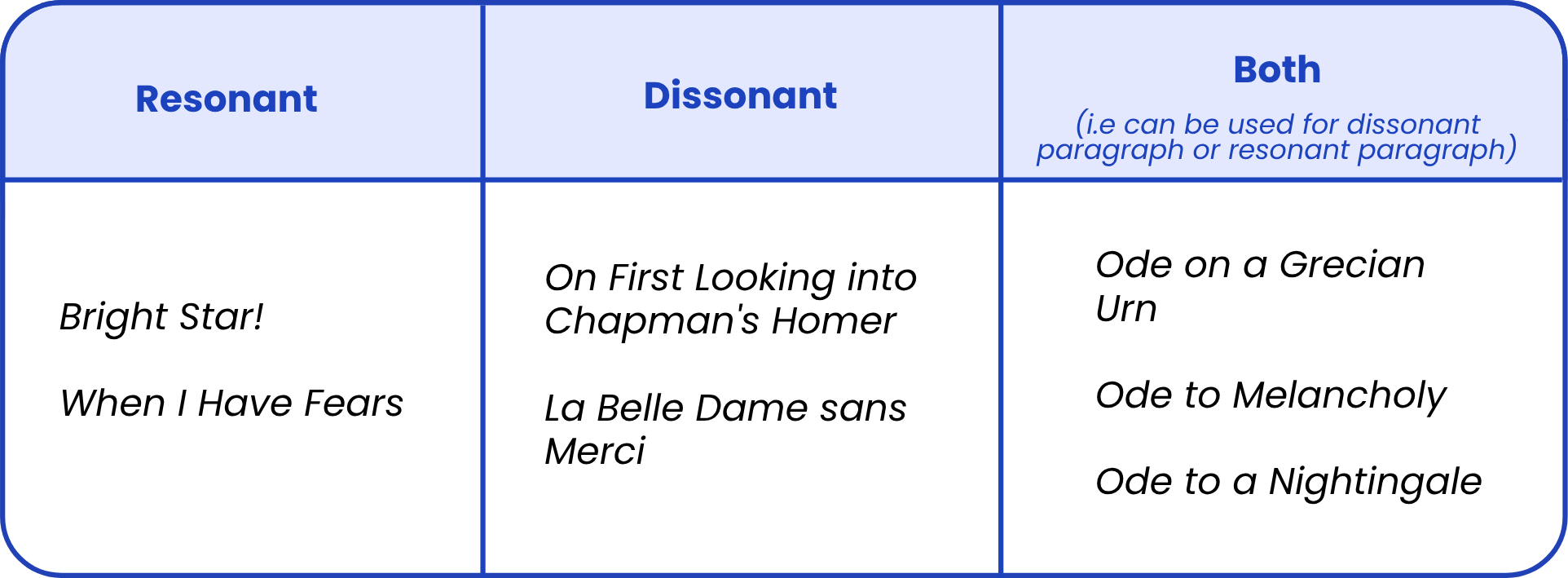
First paragraph: Establish the conversation with resonance
Begin with a poem that has a clear, direct link to Campion’s film — one where the two texts are visibly in dialogue and your comparative argument can be established with confidence. Bright Star! is the most natural choice: the intertextual connection is explicit (it is the film’s title), and the comparison between Keats’ poem as cosmic meditation and Campion’s reading of it as intimate declaration is immediately available and essay-ready. When I Have Fears is an equally strong opening if your essay’s central concern is legacy — the poem’s anxiety about dying before his creative work is complete maps directly onto Campion’s humanising portrait of a man who feared irrelevance, and whose fears were answered posthumously. Ode to a Nightingale can also open an essay when mortality and the limits of transcendence are your primary focus.
Second paragraph: Deepen with dissonance
Your second paragraph should move into more contested ground — the places where Campion most explicitly challenges, reframes, or inverts Keats’ values. La Belle Dame sans Merci is the most pointed dissonant poem: its treatment of women as dangerous archetypes stands in direct contrast to Campion’s rehabilitation of Fanny Brawne, and the gap between the two is where your most powerful feminist argument lives. Ode to a Nightingale can serve a dissonant function here too, if your reading focuses on the contrast between Keats’ solitary, inward imaginative flight and Campion’s insistence that creativity and emotional truth are always relational, embodied, and tied to the women in Keats’ life that his poetic tradition rendered invisible. On First Looking into Chapman’s Homer offers a different kind of dissonance: the Romantic elevation of art as transcendent discovery set against Campion’s grounding of aesthetic experience in ordinary, embodied, intimate human life.
Third paragraph: Synthesise
Your third paragraph should do the most sophisticated work in the essay — showing not just where the texts agree or disagree, but how their resonances and dissonances together produce a larger meaning than either text achieves alone. Ode on a Grecian Urn and Ode to Melancholy are ideal here precisely because both resist easy categorisation: they can be read as resonant or dissonant with Campion depending on how you frame them, which is exactly the kind of complexity a synthesis paragraph needs. Ode on a Grecian Urn resonates with Campion in its meditation on the tension between permanence and living experience, yet is also challenged by her — the film ultimately rejects the urn’s logic of preservation in favour of ephemeral beauty. Ode to Melancholy resonates in its embrace of transience as the very condition of beauty, yet Campion extends the poem’s philosophy into lived, embodied female grief rather than abstract philosophical counsel.
If you do a four paragraph structure, I recommend for your first paragraph (on Keats’ poetry) you use a resonant poem. Then, for the third paragraph (or paragraph 2 with Keats’ poetry) you do a dissonant poem. Below is a table.
Part 4: Conceptual lenses
1. Love and Desire
Love and desire in both their romantic and philosophical dimensions are among the most enduring preoccupations of human art, and the thread through which Keats and Campion's textual conversation is most immediately felt. In Keats' early 19th-century Romantic context, love is internalised: mediated through imagination and symbol, the beloved exists as ideal or archetype, and desire is expressed as longing rather than reciprocal relationship. Poetry internalises desire through language and imagination, giving the speaker no interlocutor — only the object of his longing, addressed or imagined. Campion, drawing on a postmodern lens and social realism, grounds this idealisation in lived, relational, socially mediated experience. Love in Bright Star is mutual but constrained — by class, finances, and Brown's active opposition — and film externalises desire through action, gaze, and mise-en-scène rather than introspective lyric. Love moves from idealised Romantic longing in poetry to something as much about negotiation and vulnerability as it is about longing.
Some evidence you might want to include:
Keats:
- “Pillow’d upon my fair love’s ripening breast / To feel for ever its soft fall and swell” (‘Bright Star!’): sensual imagery — abstract longing made intimate and physical; the paradox of seeking the eternal within the mortal body
- “Still, still to hear her tender-taken breath, / And so live ever — or else swoon to death” (‘Bright Star!’),near-rhyme of breath/death — vitality and mortality fused; love as the only redemption from mortal anxiety
- (‘La Belle Dame’,): oneiric ballad structure — desire reduced to seduction and entrapment; the knight left desolate, unable to escape the cycle of longing
Campion:
- When Keats recites ‘Bright Star!’ to Fanny, Campion manipulates proxemics to have Keats’ physically rest upon Fanny’s breast, describing a more physical version of love
- Closing title card: Fanny “never forgot John Keats” — legacy preserved through human memory and love, not canonical status; the film extrapolates Keats’ legacy by focusing on his intimate life, not just his art
- Pathetic fallacy of Spring as Fanny and Keats go on a sort of date together with Toots.
2. Mortality and Legacy
Mortality and the human desire to outlast it through art is the anxiety that most directly shaped Keats' life and the preoccupation that most visibly connects his poetry to Campion's film. In Keats' Romantic context, with his short lifespan, personal anguish, and preoccupation with fame, mortality is the engine of creative ambition: abstracted through metaphor and introspection into poetic anxiety about unfulfilled legacy. Poetry contemplates both death and legacy abstractly; the speaker's imagination remains in motion even as the body fails. Campion, working with historical realism and the hindsight of Keats' posthumous canonisation, refuses this abstraction. Film visualises mortality through embodiment, narrative tension, and the pathetic fallacy of winter. At the same time, the film reframes legacy: from anxious anticipation to affirmed, tangible endurance, enriching Keats' legacy not just as poet but as a deeply human figure whose love and suffering endure through memory.
Some evidence you might want to include:
Keats:
- ‘Before my pen has gleaned my teeming brain, / Like rich garners the full ripened grain’ (‘When I Have Fears’, ): extended metaphor, the mind as unharvested farmland; death as the threat of creative incompleteness
- ‘Where youth grows pale, and spectre-thin, and dies’ ('Ode to a Nightingale', ): gradation — extended imagery describing the inevitability of aging.
- ‘Thou wast not born for death, immortal Bird!’ (‘Ode to a Nightingale’, ): motif of Nightingale as the poet that can be immortalised through their poetry
Campion:
- Close-up shots of Keats coughing blood and physically deteriorating make viscerally concrete what the poems only fear in the abstract; mortality is lived, not philosophised
- When Keats reads ‘When I Have Fears’ to Fanny, Campion omits the volta — the reading becomes a vulnerable, unfinished gesture; Keats has not yet accepted his fate at this point in the narrative
- Pathetic fallacy of winter — bare trees, cold light in the film’s final act — externalises what the odes internalise through metaphor and introspection
3. Beauty, Truth and Ephemerality
The relationship between beauty, truth, and time — specifically, whether beauty can or should be preserved in art, or whether it derives its power from its very impermanence — is the philosophical heart of this comparative study. For Keats, drawing on Romantic aesthetics and the pursuit of ideal truth and the Sublime, beauty transcends mere form: it becomes an intense emotional experience intrinsically linked to imagination, and poetry immortalises beauty linguistically, elevating it toward the timeless and abstract. Campion, drawing on cinematic realism and postmodern sensibilities, shifts this entirely toward relational authenticity: film depicts beauty experientially, through gaze, gesture, and mise-en-scène, grounding it in specific people and moments rather than universal principles. Beauty moves from eternalised, abstract ideal to something transient yet emotionally connected — and it is precisely the transience that gives it its power.
Some evidence you might want to include:
Keats:
- “Heard melodies are sweet, but those unheard / Are sweeter” (‘Ode on a Grecian Urn’,): paradox/synaesthetic imagery — privileges the imagined and idealised over lived experience; beauty located in imagination rather than direct sensation
- “Beauty is truth, truth beauty” ('Ode on a Grecian Urn', ll.49-50): chiasmus/prosopopoeia This aesthetic assertion is inherently ambiguous and indulges in Keats’ concept of negative capability. A common reading is that it may suggest that beauty offers its own intuitive mode of truth, apprehended through feeling rather than reason.
- “Then felt I like some watcher of the skies / When a new planet swims into his ken” (‘On First Looking into Chapman’s Homer’,): Romantic simile — aesthetic encounter as Sublime revelation; beauty as sudden, overwhelming truth
Campion:
- Butterfly capturing montage: butterflies die when contained — beauty inseparable from brevity,
- Freeze-frame games with Toots alongside non-diegetic score mirror the urn’s frozen lovers — but the film moves on, insisting life cannot be held still
- The film’s primary motif of letters — communications written for one person, in one moment; truth found in particularity and intimacy rather than posterity
4. Imagination and Creativity
The imagination — understood in the Romantic tradition as the creative faculty through which emotional experience is transformed into meaning — is the supreme value in Keats’ poetry, and the lens through which Keats and Campion most radically disagree about the nature of creativity. In Keats' Romantic framework, imagination is the ideal of the solitary genius: internal, aspirational, and fundamentally individual. The poet meditates alone; emotional intensity and personal reflection are the sources of imaginative seizing. Yet even within the poetry, imagination is complicated — ‘La Belle Dame’ reads as allegory for its dangers, the knight destroyed by unchecked fantasy. Campion, drawing on historical realism and a postmodern awareness of collaboration and influence, relocates creativity in social negotiation and relationship: imagination in the film is externalised both visually and narratively, emerging from Keats' relationship with Fanny rather than solitary contemplation. Imagination moves from internal and idealised to relational and socially grounded.
Some evidence you might want to include:
Keats:
- "Not charioted by Bacchus and his pards, / But on the viewless wings of Poesy" (‘Ode to a Nightingale’,): metapoetic reflections— imagination set against material stimulation as the means of transcendence in art
- ‘the fancy cannot cheat so well / As she is famed to do, deceiving elf’ (‘Ode to a Nightingale’,): personification — imagination revealed as unreliable; the escape it offers is temporary and unstable
- ‘Was it a vision, or a waking dream? / Fled is that music: — Do I wake or sleep?’ (‘Ode to a Nightingale’,): accumulated rhetorical questions — negative capability; refusal to resolve whether imagination offers genuine insight or mere illusion
Campion:
- Aerial shot of Keats in the treetops visually echoes the poem’s imaginative elevation — but grounds imagination and creativity to be inspired from interacting with nature in reality rather than solitary meditation
- Before leaving for Rome, Keats appeals to illusion with Fanny — the private imaginative act becomes a shared, mutual act of survival; creativity is relational
- Fanny’s engagement — reading his letters, sharing poetry, debating — is positioned as creative catalyst, not incidental backdrop; imagination in the film is always collaborative and relies on real world events of artist to inspire creativity
5. Gender, Class and Power
The question of who is granted a voice in art and history is the sharpest dissonance in this comparative study, and the one Campion most deliberately sets out to redress. In Keats' Romantic context, shaped by patriarchal norms, class insecurity, and a tradition of symbolic femininity, women tend toward archetype rather than person: viewed, imagined, or allegorised, never heard. Poetry in this tradition neglects the female voice and perspective entirely, aestheticising femininity as symbol. Campion, drawing on a realist and feminist-informed perspective, reframes this with historical accuracy and contemporary purpose. By centering Fanny Brawne as the film’s emotional and intellectual protagonist, the film emphasises a new female voice and adds a layered critique of patriarchal 19th-century aesthetic values. Romantic ideals are reframed within gendered and material realities — love and creativity are shown as negotiated within social, economic, and gendered contexts that the poetry, by convention and context, could never acknowledge.
Some evidence you might want to include:
Keats:
- ‘a faery's child, / Her hair was long, her foot was light, / And her eyes were wild"’('La Belle Dame',): archaic diction/allegory — the female figure refused humanising characterisation; defined entirely by how she unsettles the male speaker
- ‘She dwells with Beauty — Beauty that must die’ (‘Ode to Melancholy’,): personification — melancholy and joy both personified as feminine figures gazed upon and consumed by a male speaker; women as allegory for emotional states rather than as persons
Campion:
- Brown’s dismissal of Fanny’s interest in poetry is staged as patriarchal gatekeeping — shown to be wrong as Fanny engages with the poetry seriously, independently, and on her own terms
- Opening montage of Fanny sewing emphasises the creativity of women to have always existed but be simply undervalued.
- When Fanny recites ‘La Belle Dame Sans’ to Keats, she is positioned as a creative equal to Keats’.
Part 5: Exam Question Breakdowns
Module A questions fall into three distinct types, each demanding a different strategic approach. Below is a breakdown of each type, with strategic advice and three example questions for each.
Type 1: Rubric-Based Questions
What they are
These questions are built on the concept of what a textual conversation is and does. In their most direct form they use rubric terms explicitly — resonances and dissonances, reframe and reimagine, context and form. More often they present a metaphor that needs to be unpacked in your essay but broadly links to the idea of how two texts relate and generate meaning through dialogue.
Here is a four step process to tackle Rubric-Based Questions;
- Identify the key terms. Pull out the operative words and phrases.
- Find the ambiguities and generate mini-questions. Every rubric question contains productive ambiguity. Normally you must find connections to the rubric yourself and define how those rubric terms are explored in your essay.
- Figure out your job as the essay writer. What are the obligations of the question? What stance does it require?
- Build a semantic field. To sustain engagement with the question's language without repeating the same words, develop word associations before you write and draw on them throughout.
Example question
In textual conversations, the later text fills in the gaps and silences left by the earlier text, thereby offering new insights. To what extent does this statement resonate with your understanding of the textual conversation you have studied?
Step 1 — Key terms: fills in; gaps and silences; new insights
Step 2 — Mini-questions:
- What are these gaps and silences?
- How do they manifest within these works?
- What are these new insights?
- How does studying these gaps and silences offer new insights?
- Does the later text actually fill them in?
Step 3 — Your job: ‘To what extent’ demands a clear stance on: (a) how effectively Campion's film does fill in Keats' gaps and silences, and (b) what new insights are offered as a result.
Step 4 — Semantic field: Instead of repeating "gaps and silences" throughout, draw on: empty, hollow, echo, absence, voiceless, excluded, unsaid, suppressed.
Type 2: Thematic Questions
What they are
These questions name a concept and ask how your study of the textual conversation has altered or expanded your understanding of it. They draw on text-specific thematic territory which for Keats’ and Campion are often: legacy, art and artistry, ephemerality, beauty and truth, negative capability, gender, love and connection, death and mortality, desire, imagination.
Strategy
Below is a three step process I recommend to help you answer these types of questions:
Step 1 — Brainstorm the theme’s full conceptual range: Before touching your texts, take sixty seconds to expand the concept as far as it will go.. The more dimensions of the theme you can identify, the richer and more original your comparative argument will be.
Step 2 — Rewrite your thesis through the theme: Your thesis must define what the study of the conversation has revealed about this theme that could not be understood from either text alone.
Step 3 — Check every topic sentence. Each paragraph’s topic sentence must make a claim about how the theme illuminates a facet of the textual conversation, not just how one text treats a specific theme.
Example question
How has your study of the conversation between Keats's poetry and Bright Star altered and expanded your understanding of desire?
Step 1 — Theme conceptual range: desire here could mean romantic love. But also contemplate other potential readings of ‘desire’. For example, desire for legacy, desire for connection, Romantic desire for Sublime, desire to experience the moment.
Step 2— Thesis: here could be something like…The conversation between Keats’ and Campion augments an understanding of desire as merely a sensual romantic sensation, instead expanding and redefining ‘desire’ to comprise a litany of ongoing human aspirations: for legacy, for ___, for ___.
Step 3 — Check every topic sentence. — For your own essay, contemplate how you can frame each concept to be interlinked with the idea of desire based on the full conceptual range of the theme per step 1.
Type 3: Excerpt-Based Questions
What they are
These are the most technically demanding question type. You are given a prescribed extract — either from one of Keats' poems — and/or an image from Bright Star, and asked to discuss how the extract contributes to the broader textual conversation. Crucially: you must know the film visually. Being able to identify what moment in Campion’s text a film still or part of script is from is critical to be able to understand ideas from the moment which you may use to springboard your essay.
Strategy
Below is a four step process I recommend to help you answer these types of questions:
1. Identify the conceptual relationship between the excerpts. Why have these been paired? What miniature conversation do they instantiate?
2. Establish the extracts in your thesis as the foundation for the broader discussion.
3. Integrate the extract’s language into your topic sentences — single-quotation marks let you lift specific phrases as a sustained touchstone without over-quoting.
4. Control the close analysis ratio. Don’t let the extract crowd out your wider poem-and-film evidence, but also do remember to perform at least one eta/iqvte of the provided extract.
Quick-reference: core concepts per poem (for if you get any of these poems as extract)
- 'Ode to a Nightingale' — imagination, creative potential, Sublime/nature, transcendence of the mortal world
- 'Ode on a Grecian Urn' — art, beauty, impermanence, truth, the aesthetic as repository for eternal beauty
- 'Bright star!' — nature/Sublime, love, death, immutable beauty
- 'Ode to Melancholy' — emotional experience of life, paradoxical relationship between sadness and beauty
- 'La Belle Dame sans Merci' — dangers of imaginative indulgence, gender, the femme fatale
- 'On First Looking into Chapman's Homer' — artistic experience, intellectual vs emotional engagement
- 'When I Have Fears' — legacy, mortality, desire for literary greatness, tension between mortal existence and permanence
Example question:
How do the extracts provided contribute to a broader textual conversation between the pair of prescribed texts that you have studied in Module A? (HSC 2021)
Out went the taper as she hurried in;
Its little smoke, in pallid moonshine, died:
She closed the door, she panted, all akin
To spirits of the air, and visions wide —
No uttered syllable, or, woe betide!
But to her heart, her heart was voluble,
Paining with eloquence her balmy side;
As though a tongueless nightingale should swell
Her throat in vain, and die, heart-stifled, in her dell.
(from The Eve of St Agnes, XXIII)
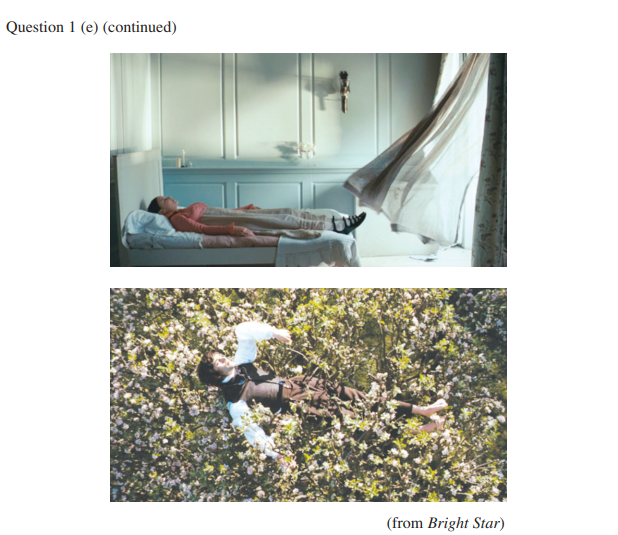
(First note that The Eve of St Agnes, XXIII is a poem from the old hsc syllabus so will no longer be assessed).
Step 1 — Conceptual relationship: Voicelessness and the suppression of female interiority is evident in the poem. The film still of Fanny and Keats in their separate domestic spaces generates a visual parallel — a match-cut that simultaneously shows their emotional alignment and their physical and social separation. Together they instantiate a miniature conversation about female and male access to voice, wonder, and aesthetic expression.
Step 2 — Thesis example: ‘The 23rd stanza of 'The Eve of St Agnes' and the images of Fanny and Keats horizontal in their respective domains instantiate the broader textures of the textual conversation, as their shared concern for the silenced voices of the marginal — especially women — points to an ongoing dialogue on the distinctions between male and female access to aesthetic beauty and a creative voice.’
Steps 3–4: Integrate words from the stimulus poem, such as “tongueless,” “voluble,” “heart-stifled” across your topic sentences.. Every topic sentence names how the extract contributes; every link sentence generalises the insight outward. Don’t over-analyse the stanza at the expense of your wider evidence, but remember to incorporate at least one piece of analysis from the poem and film stills.
Part 6: Wrap up
Hopefully this text guide provided you with a useful overview of the most crucial elements of a comparative textual study between John Keats’ poetry and Jane Campion's Bright Star.
A final piece of advice:
The critical distinction between a strong Module A response and a merely competent one is whether the student is making genuinely comparative arguments or simply parallel summaries. Keats and Campion are not simply talking about the same things or discussing completely different ideas. They are answering each other — across two centuries, two genders, two mediums, and two fundamentally different ways of understanding what art is for.
If you can convince your marker that you understand why these two texts are in conversation, you should be well on your way to getting a 20/20 on your module A Keats/Campion essay!
.svg)
Related Posts
.png)
.png)



Related Posts